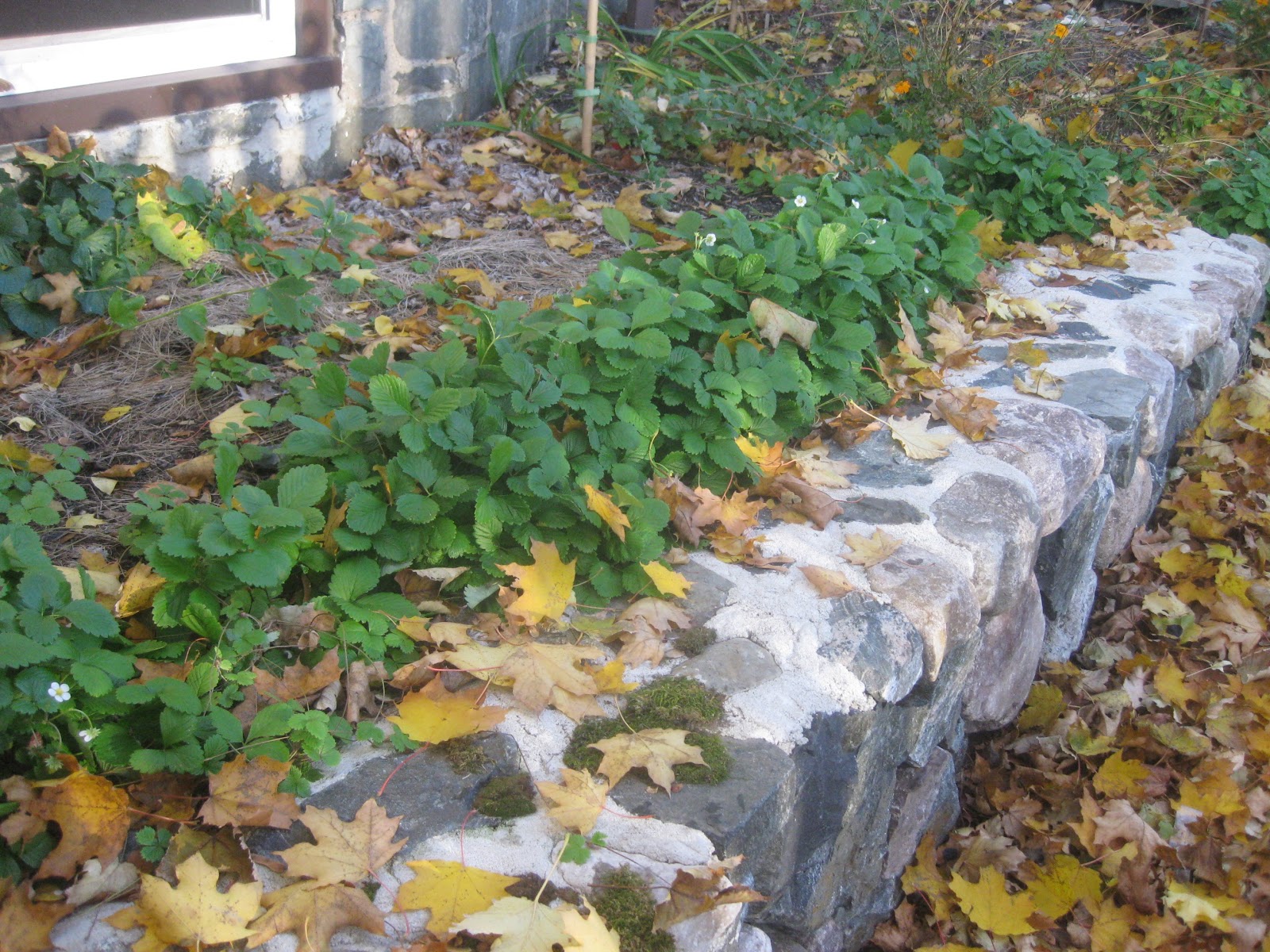
Perennials are coming along, most of them more slowly than I'd like. Some died. Strawberries were a huge success, others gave a couple fruits and berries. We planted some new edible vines and shrubs.
In other recent posts I have written up
Apples,
perennial greens & herbs, and
alliums. But there are plenty of other plants I feel the need to write up!
June Bearing Strawberries
Strawberries were by far the best thing that we ate from the yard last year, and needed relatively little work to manage. This was their first season fruiting, and we were astounded by the volume of utterly delicious fresh fruit kicked out by our 8.5 square meters devoted to two varieties of June bearing plants. In spring 2014, we planted Earliglow in 5 bed squares in the west back terrace, Sparkle in 5 bed squares in the east back terrace. Both sets of plants were from
Nourse, and both made very good fresh berries.
We also visited our CSA (
Red Fire) in June and picked lots of strawberries (and peas), which added to the profusion of amazing fresh berries.
This yearly trip to western MA is always combined with a visit to our good friends and ex-housemates Alexi and LeeAnn (though LeeAnn couldn't make it this time).
I had put straw over our berries after cold weather set in during fall of 2014, and we pulled the straw off in early spring 2015. It wasn't long before the plants were erupting in a profusion of new growth. Becky did the thinning and derunnering as the season progressed.
Then flowers started to appear, and not long after that, the first fruits.
We picked and ate Earliglow in the first couple days of June. Here is Child 2 eating peas and berries from the garden on June 3.
After a week or two during which time Earliglow was ramping up output, Sparkle came online. Despite Earliglow being described as very early, and Sparkle as mid-late, they overlapped by most of their fruit season. We were picking strawberries almost every day for the month of June, with peak production sometimes bringing in more than 4L per day. I never thought in the small amount of space we had we could manage to grow more strawberries than we would be able to just eat fresh, but my expectations were exceeded. Despite absolutely gorging ourselves on strawberries to the tune of 2 or more liters a day, we still had enough to give some as presents to friends and neighbors, bring some as party favors, and freeze a bunch for later use.
They are definitely less good after freezing, and lose tons of liquid after thawing, but they are still quite tasty in plain yogurt or along with some chiffon cake. One approach which has worked well is to let them thaw, drain the liquid, then boil down the liquid into a syrup, cool a little, then reapply to the strawberries or pour over the top of whatever you are eating the berries with.
Earliglow was on the whole better than Sparkle. The yield was higher, and the berries were a little firmer, so got less mushed and bruised while picking. The Sparkle plants were also rather too vigorous and got themselves crowded, even with thinning in spring and occasional runner pulling. The combination of the softer berries and more crowded plants resulted in many berries being lost to mold.
Notice the barren bed behind the Sparkle plants - this is where asparagus is
supposed to be growing. More on that later.
To combat the high vigor of Sparkle, Becky thinned plants more brutally after renovation. They didn't come back as well after this treatment as the Earliglow, perhaps due to the less favorable conditions in summer on the east side of the terrace. We'll see what happens with them in 2016.
One thing Sparkle has in it's favor is a slight edge in flavor, in my opinion. I thought the sweetness and richness of the taste was a little better than Earliglow (which was also very good). However, Becky did not agree with me on this point.
We had almost no issue with birds or animals eating the berries. Hopefully this will continue, but if the birds wise up these beds won't be too difficult to net. I bought net actually, but didn't bother to put it on when it became clear it wasn't necessary.
After Sparkle had petered out at the end of June, we "renovated" the strawberry bed.
The plants were cut down in a few minutes of work with the
scythe. Of course the kids all wanted a try. I should get them a kid sized scythe... don't all 5 year old children want scythes?? For some reason they don't carry them at Home Depot.
Child 2 is looking cute here in her second hand Little Mermaid pajama dress, accessorized with a man sized Austrian scythe.
The cut plants were put in the compost,
and I frosted the beds with compost and topped off with a layer of salt marsh hay as mulch.
In a week or two, new growth was peeking through, though the Sparkle side seemed to have a more difficult time with it.
Later in the summer the plants were doing great, especially the Earliglow on the west side.

The recommended approach to June bearing strawberries is to rotate them out after three years, into a spot which has not had any nightshades for three years. Well, that is difficult to arrange in our tiny amount of growing space, if I want to grow nightshades. So I'm often mentally juggling which beds to NOT grow nightshades in for at least two years ahead of putting strawberries in them. Plus there is a dead year the first year the strawberries are put in, so if you don't want to skip a year of harvest the garden will be low on space that year for anything else. I'd like to stretch the time to 4 years if possible, and I saw one person's recommendation for adding sea minerals to the strawberry beds to extend their run. A pack of Sea-90 was duly purchased on amazon, and some was sprinkled on the strawberry beds. Perhaps when we replant the strawberries in a new spot in a couple years, we might choose some day-neutrals in addition to June bearing, to spread the harvest over a longer period. Having it concentrated does have some benefits as far as reduction in total labor goes however.
In late fall, I pulled some runners and baby plants which were out of bounds,
and put on a top layer of salt marsh hay. Looking forward to another great strawberry year starting in June. We shall have to focus on eating up all the leftovers from last year out of the freezer for the next couple months.
Alpine Strawberries
The side yard leading from the driveway to the back was in need of more food plants. I decided to try some alpine strawberries along the path; it is not full sun there and I didn't want anything too tall. In february of 2015, we planted pre-chilled seed of Alexandria, Mignonette, and Yellow Wonder and put them under lights in the basement.
As spring progressed we prepared the planting site. Hay put down over the winter was pulled off, and we unleashed the power of the new broadfork.
That tool is fantastic. Then we put down some more compost and some granules of soil acidifier mix (pelletized sulfur).
We put the seedlings out I think in late April, but by end of May they were still very tiny. I started getting concerned that the ones from seed were not going to thrive so I bought a tray of plugs from
thestrawberrystore.com. Thinking that it might be great if the plants spread themselves about the area as groundcover, I thought I would try the variety
Atilla, which is one of the only alpines which puts out runners. In retrospect this may have been a mistake! Now there are runners going everywhere. Duh.
Actually most of the seedlings caught up to and exceeded the plug plants by fall. We even got flowers and berries, thought not a huge number of them.
Going from seed to fruit in one season is pretty impressive for a perennial. Go alpines! It is nice how they are just constantly kicking out a steady, if small, stream of fruit. It was fun for the kids to be browsing in the leaves almost every day to see if any were ripe. They were confused and amazed by the Yellow Wonder.
I scattered extra plugs of Attila around the yard in different places which seem to be difficult for plants. The woody sidebar by the driveway, west side yard (very shady), under a big maple. Mostly they did not thrive, but they are still alive enough to make runners. The thread-like runners are ~0.5mm diameter and barely visible; they are tough to see until a new plant starts growing.
By fall we had a pretty bushy path border of alpine strawberries. We put in some crocus bulbs under the leaves of the strawberries right up against the brick edges. Already these have started coming up, but not flowered quite yet.
I put some hay and leaves over the strawberries for winter, but being next to the bricks this light mulch tends to get blown off the plants by the intense wind that whips around the northeast corner of the house.
The kids are still young enough to think raking is fun, especially if they get to jump in the leaf pile afterwards. We keep all the leaves from our yard to use as mulch and compost. We don't bother to rake most areas at all, really only pulling excess leaves off the back grass and path once.
The alpines look to have made it through the fairly wimpy winter of 2015/16 with no problems - we did have one morning it was down to -21C (-6F), but only briefly. Anyway, they ought to be very cold hardy if you put any stock in their name, right?
More Berries and Fruits
Nanking cherries
These got kind of crushed by the snow, ice, and sledding kids of the winter of 2014/15. One bush is looking a little weak, and I wish both were growing faster. There were a couple flowers in spring, but no fruit yet.
Cornelian Cherries
Picked up steam in their second leaf, put on a respectable amount of growth and looked less sickly than the first season. Even made a few flowers and one tiny fruit, but it fell off and was lost before it got ripe.
Red Currants
Jonkheer van Tets in second leaf grew well and made 5 berries, enough for one currant each for our family. The plant is right below a huge gutter leak and gets drenched when it rains and covered in ice in fall and spring. It doesn't appear to mind much though.
Jostaberry
Finally grew a little in second leaf. Hopefully will get going next season. Still very small. Seen here with some fantastic orange cosmos my mom gave me a few years ago and which self seed easily.
Gooseberries
Hinnomaki Red got utterly crushed by falling ice it's first winter, but came back pretty well last season.
No sign of flowers or fruit. I planted a Jahn's Prairie on the west side of the house.
Clove Currants
One under a maple is barely alive and essentially hasn't grown at all since being planted. I don't have high hopes for it. Even the runnering alpine strawberry I put there is struggling. I planted a second one in the west sideyard last season and it looks much happier. The new one made a single berry, but it fell off before ripening.
Blackberries
5 Chester plants struggling along in the east side yard.
We got some fruit last summer, but the plants are not growing all that well. I wonder what the issue is. Put down a heavy blanket of compost in this area last fall, hoping for improvement this coming summer. I also plan to make a basic wire trellis to keep the canes from flopping into the nearby path.
Raspberries
In the same part of the yard as the Blackberries, and also struggling to get going. They are growing and expanding but very slowly. We ate maybe one handful of berries last season, but they were small, shaped poorly, and sour.
Goumi
Growing fairly well in second leaf here, no sign of fruit.
Haskap/Honeyberry
Planted in barren maple covered sidebar, they were going very slow. Then they got run over with a lawnmower from the neighbor's landscaping crew. Grrr. That's what I get for putting them on the property line I guess. Replanted them in a less likely to get mowed spot, plus a third new plant. I'm not sure these will actually succeed.
Aronia
Two Viking planted last summer acclimated to the tough sidebar location. But then got crushed by ice, then trampled by a tree crew. I moved them to make room for some new plants and half expected them to die, but they grew a little and refused to give up.
Autumn Olive
A hated plant by many, but I think the berries are great. I eat countless handfuls of
foraged berries when they are in season on my bike commute from work. The one I planted last season is a selection from
Edible Landscaping (not listed this season it seems). It grew a lot the first season in the ground in a location that is challenging for other plants.
Hazel
A few that were planted in 2014 are still scraping by, but most were dug up by squirrels. We ordered more from
Badgersett Research in 2015 and planted them in a small section of the back terrace bed, with a basic cage over the top to discourage squirrels. Most of these survived. When they get bigger in a couple years I'll separate and transplant them.
Chinquapin
Put two of these from Edible Landscaping into the dreaded maple sidebar. Like most stuff I get from that source, they arrived looking good but got weak after planting. By the end of the summer though they were perking up and grew a little. No sign of any buds swelling yet; did they die over the winter...?
Wintergreen
Planted in 2015 and doing well. Made a couple berries.
Grape
Put in a Mars Seedless grape by the back porch. It grew a little bit toward the end of the season. I hope to grow it up on a trellis which I have yet to build. It looks bad in this picture, but it started looking better toward the end of the season.
Hardy Kiwi
Still worrying about the integrity of the
back fence in high wind, I ended up running two stainless cable tension stays down to a lower post on either side of the fence.

These cables looked like a good opportunity for a fruiting vine. Another factor is that the top of the back fence now seems to be a squirrel highway, and if there are eventually apples on the top rung of the back espalier it will be like a squirrel drive-through fruit stand up there. But not if there were a big gnarly vine on the top of the fence! So I planted an Anna kiwi on the east side in hopes of growing it up the cables and partway across the top of the back fence. I'm a little scared of what monsters kiwi vines can become and the pruning needed to keep them under control, but we'll see. More likely given the performance of other plants in that area it will struggle along and runt out. A male was planted very close to the Anna, but petered out after a month or so. In the below pic, both kiwis are in the back left behind the pot of Child 1's mint plants. Center ground is a Nanking cherry.
Other permie favorites
Asparagus
Ugh. Everyone says asparagus is easy to grow, but not for us. Some crowns survived from 2014, but most had died. We gave the bed a gentle broadforking and planted a bunch of seeds. Most grew into seedlings, but many died in the hot and dry east side of the terrace bed. We'll see what comes up this spring and probably go for another round of seeding. I should get the soil tested again to see if anything is missing and if the ph is in range.
I think we might have asparagus beetles in the west side of the bed too. The bugs in question look like ladybugs but are more orange than red. Here are some pics from fall.
Comfrey
Whew, what a vigorous plant! I cut it down once with the strawberries at the end of june and trimmed leaves for mulch a few other times. Looks neat when it is early in the season and the flowers are pretty, if a little ungainly. Here is is in fall (there are two plants in a ~1m square area).
New Plants Coming for 2016
Apricot
Tomcot on Citation from
Bay Laurel and Hargrand on Pumiselect from
Cummins. These will go on either side of the walkway to the steps of the back terrace bed, in the lawn area. I prepped a bed next to the compost house last fall. First I took the grass off and put it in the compost or used it to patch other lawn areas. Next I broadforked the soil and put in the wood edging. Then we put down some cardboard and topped with compost. And last, a layer of hay for the winter. We dug in and planted the Tomcot this weekend.
Man, were the roots butchered on that bare root tree. They were just little stumps a like 5cm long! I've read online that this is standard practice for Bay Laurel. I'm used to seeing strong and profuse roots on the bare root plants I've previously bought from Fedco and Cummins. I pruned the top back hard, hoping to compensate for the gimpy roots.
Grapes
Marquis and Blue Muscat, both seedless from
One Green World. These will hopefully get grown up around the west side gate and portal. I need to build some beds and trellises for them.
Kiwi
A replacement for the male I planted last season, which I'm pretty sure died.
Arctic Raspberry
Anna, Beta, Sophia, and Valentina from One Green World. I had never heard of these, but they came up in a thread on GrowingFruit.org and I wanted to try them out. A groundcover type plant which grows raspberries; sounds excellent!
Bush Cherry
Reading GrowingFruit.org makes one want to plant all manner of new fruit. I do have an opening for a bush between a Chinquapin in front and a big sycamore maple, and decided to try out Juliet, a variety of bush cherry in the same family as Carmine Red that gets good reviews from most. Self fruitful which makes things easier.